


Please visit ProfEC Ventus GmbH Website for further information with respect to our accredited services and expert opinion reports, or ask for an individual quotation that meet your needs.
Installation und Bewertung von Windmessungen
0,00 €*
≈0,00 $
≈0,00 AU$
≈0,00 £
≈0,00 R$
≈0,00 ¥
Wind Measurement System Configuration
Accredited as testing laboratory following ISO/ IEC 17025:2005 for installation and evaluation of wind resource measurements conform to IEC 61400-12-1, MEASNET and FGW standards
We offer appropriate sensors for everything relevant to be measured
For high quality, banks-conform wind measurement campaigns, as requested by experienced banks and investors, the entire measurement system should be tailor-made to the wind project planned at a specific site. Thereby in any case it is crucial to comply with pertinent standards, and even to go beyond them. The equipment standardly recommended by ProfEC Ventus is in line with ISO / IEC 61400-12-1 and MEASNET (as the most frequently considered benchmark for bankable measurement equipment and measurement system characteristics), and also can be tested against any other banks requirements worldwide. Highest reliability and accuracy of the measurement systems are our superior objective, lowering the uncertainties involved!
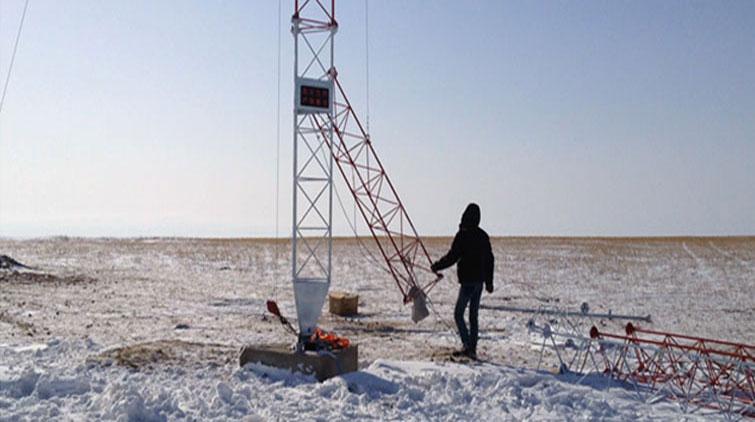
Our onshore wind measurement masts rage from 40m to 160m and include tubular as well as lattice tower structures from galvanized steel or aluminium.
Our free-standing offshore wind measurement masts range up to 110m height with boom lengths of about 20m.
We deliver and/or install individual equipment components as well as pre-confectioned measurement systems including all cables and junctions for out of the box installation and operation.
Suitable sensors, equipment, industrial data logger with flexible configuration, calibrations and communication interfaces like UMTS, (W)CDMA(2000) or satellite modems enable our clients to access their measurement stations at any time and virtually anywhere in the world. As fall-back option Serial, USB and Compact Flash interfaces can be used. If any wireless network is present, data files to the Client and/or to our Virtual Measurement Access (V.Mac) Platform on a daily base.
All items are proven and do operate under most extreme conditions from -50°C in the middle of a snow-desserts of Mongolia to + 60°C like in highly remote desert conditions, or rural, tropical oceanic island situations. Our systems provided still achieve a complete 100% data coverage even under such extreme conditions.
For special needs, high requirements and environmental standards
We perform data logger calibraton, line-2-line calibration of the entire measurement system and we offer optional calibraiton for all measurement sensors.
In case of huge wind farm areas or (semi-) complex terrain, often several wind measurement masts are recommended. To don‘t stress the budget! Alternating masts can be applied.
A second recommendation we make are in-situ tests of the anemometers, which permits to assess, if recalibration of sensors is already needed or not yet necessary, maintaining a low uncertainty of the sensors by valid and permanent calibration. Therefore we recommend a control anemometer of different type and make compared to the primary anemometer, yielding in a more reliable and consistent result of the in-situ comparison.
Data Management and Supervision Service for all Client Stations and Data
In combination with V.Mac, we allow our Clients to real-time monitor and observe their measurement stations and data via Internet browser. V.Mac allows sharing data and reports, downloading data, inviting stakeholders with limited access to see specific data only, to easily perform quick checks on data quality and completeness, trends, etc. V.Mac service is free of charge for one year and comes with every data logger we are going to provide. We also do offer this service for other data and data loggers our Client may already have. Our V.Mac service can be applied independently of the hardware used, as long as data are made available to be stored on the V.Mac server of our Client or of us.
Also automated alert messages via email or SMS are possible, allowing to immediately take actions in case that defined threshold levels are crossed (e.g. battery voltage drop, wind speed etc.).
Please try out our V.Mac here and feel free to explore its possibilities and strengths: http://www.profec-ventus. com/services/v-mac.html and get a free test account.
Contact
Vermessung und Verifizierung von Leistungskennlinien
0,00 €*
≈0,00 $
≈0,00 AU$
≈0,00 £
≈0,00 R$
≈0,00 ¥
Power Curve Measurements and Power Performance Verification
Accredited as acknowledged testing laboratory following ISO / IEC 17025:2005 for power performance measurements and power curve verifications conform to ISO / IEC 61400-12-1, MEASNET and FGW standards
Profitable wind resource is available but where remains the prognosticated power generation?
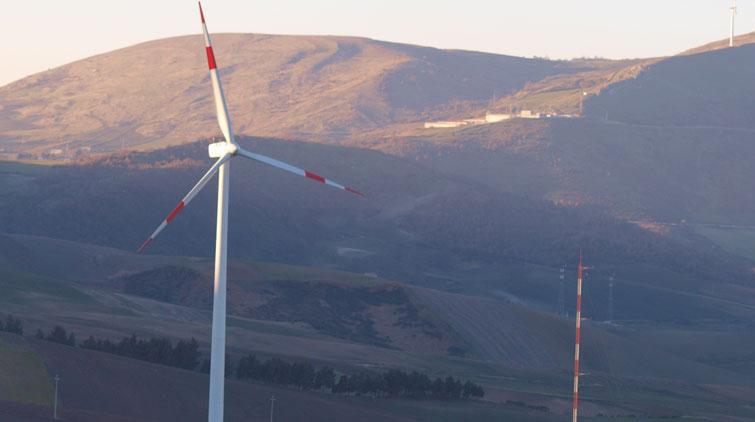
A Power Curve describes the power output generated by a wind turbine as function of the wind speed that the wind turbine is experiencing at hub height.
Both, the wind turbine manufacturers offering a product to potential clients or developing a new product prototype, in the same way as their clients, developing a wind farm project and trusting on a profitable power output of the wind turbines, have an uttermost interest to ensure that the considered power curve is met during operation and under real conditions, and that this power curve is maintained for a guaranteed period at least.
Power performance measurement and power curve certification are the appropriate means to prove this
To verify the power curve, we perform an accredited service and measure power performance according to internationally accepted norms and standards as:
IEC 61400-12-1
IEC 61400-12-2
IEC 61400-1
FGW Part 2 Rev. 16
MEASNET Power Performance Measurement Procedure V.5.
We perform power performance and wind measurements for hub heights of up to 160m by aid of measurement masts and we do perform higher measurements by aid of LIDAR remote sensing devices and techniques.
Power performance: a matter of sales contracts, advertising brochures and project cash flow expectations
Also banks and investors, having an interest in the success of a financed project, may prompt for power curve verification. Typical need for a power curve measurement and verification exists especially if:
a wind turbine, or even worse the entire wind farm, on average is not yielding the P50 expectation value referring to the annual energy yield production prognosticated. If in such case neither analyses of operational data nor due diligence of the on-site available wind resource potential could explain the underperformance: power performance measurement and power curve verification are the next recommended activities to be performed.
after the 2 year warranty period provided by the turbine manufacturer, responsibility and all technical risks are fully transferred to their actual client. Just before that moment the client (or investors) may want to have certainty that the wind turbines still are as good and as powerful as they were promoted during sales negotiations and as highlighted in brochures, but especially as agreed on in the sales contracts.
any shareholder wants to have full certainty and guarantee that the product he bought really meets the expectations and promises negotiated and agreed upon within the sales contracts and performance guarantee conditions.
a new wind turbine type or prototype is developed and tested prior or at market entry.
An appropriate wind turbine sales contract considers good performance guarantee and warranty conditions in case of wind turbine under-performance
In the end: if a wind turbine does not yield the praised power performance, compensation measures may be negotiated in accordance to the losses made based on wind turbine underperformance.
We do offer assistance during contract negotiations for wind turbines purchase, ensuring good warranty conditions (e.g. high wind turbine availability and energy yields) and appropriate guarantee conditions (e.g. financial compensations in case wind turbines fall behind any expectations) at a reasonable price.
Moreover we do perform acknowledged analyses and accepted calculations in order to determine the magnitude of financial loss as consequence of wind turbine under-performance.
Contact
Windpotenzialermittlung und Energie-Ertragsprognosen
0,00 €*
≈0,00 $
≈0,00 AU$
≈0,00 £
≈0,00 R$
≈0,00 ¥
Wind Resource and Energy Yield Assessment
Accredited as acknowledged testing laboratory following ISO / IEC 17025:2005 for wind resource and energy yield assessments conform to ISO / IEC 61400-12-1, MEASNET and FGW standards
Banks and investors welcome prognosis results derived based on accredited services, proving compliance with highest international standards for bankability
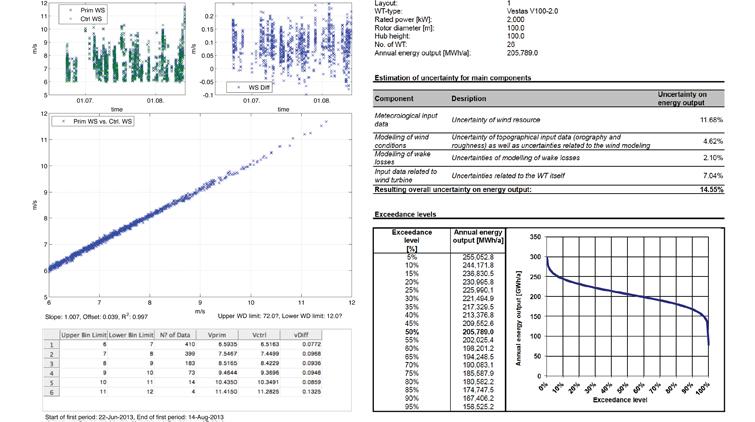
We offer bankable wind resource and energy yield prognoses, starting with data processing, evaluation, correction and finishing with bankable reporting of energy yields, including P50, P75, P90, P95 levels of confidence, assessment of losses and a vast assessment of uncertainties involved.
During data correction and uncertainty analysis we consider in-depth correction of measurement data with respect to influences that the sole physical presence of the mast causes (e.g. mast blockage, wake effect, speeding-up, lighting rod etc.).
On the way we perform advanced statistical analyses to fill data gaps in case sensors failed or the measured time series contains data gaps or errors. This reduces data uncertainty and yields in results with higher accuracy based on higher data availability. It lowers the need to exchange sensors, if a sensor shows malfunction, and as long as sufficient other sensors (preferably redundant) still maintain operative.
Each corrective action taken will be evaluated and the uncertainties of such procedures will accordingly be taken into account following ISO / IEC 61400-12-1:2005 and ISO / IEC Guide 98-3:2008 (BIPM) „Guide to the Expression of Uncertainty in Measurement“ (GUM).
Reduction of uncertainties by advanced techniques and expert insight
To further control and reduce uncertainties, a lso-called in-situ test of installed anemometers should be performed. This in-situ test is a advanced cross comparison of anemometers and permits estimation, if (re-) calibration of sensors is needed already or can be surrendered to a later time. The recalibration intervals and thus exchange of sensors can be postponed by this method, saving time and costs, and on top yielding low uncertainty related to the sensors by permanently maintaining valid calibration characteristics.
Deriving the long-term persistent wind climate on site taking into account inter-annual fluctuations
The cleaned, filtered and corrected set of measurement data subsequently need to be correlated with at least one independently verified and representative long-term valid wind regime.
Our applied procedures guarantee most accurate prognosis results for the derived long-term wind climate and hence yield highest level of precision at low levels of uncertainties.
Optimising wind farm energy yield by on-site micro-scale wind mapping
Appropriate energy yield optimization starts with optimized wind turbine locations in relation to the long-term wind resource probability (wind speed frequency distribution and wind direction distribution), topography and precise wind turbine characteristics (type of power curve, cut-off hysteresis, operational mode, etc.). Thereby a micro-scale wind resource raster (wind map) is an optimal tool to localize most promising wind turbine positions within an objected planning area and to yield an optimal level of energy generation on long term. We offer site-specific wind mapping services with very high resolution, enabling our Clients to energetically optimize a wind farm project by determination of the precise location of each single wind turbine within the wind farm. We hereby rely on linear as well as CFD models, depending on the site characteristics.
Validation of the prognosis results and determination of the level of uncertainties and assessment of the quantiles of probability for each wind turbine individually result in a bankable wind energy yield prognosis, entirely respecting our accreditation as testing laboratory regarding Wind Resource and Energy Yield Assessment of Wind Turbines (incl. Assessment of Losses following TR6 Rev.9) following ISO / IEC 17025:2005.
Contact